
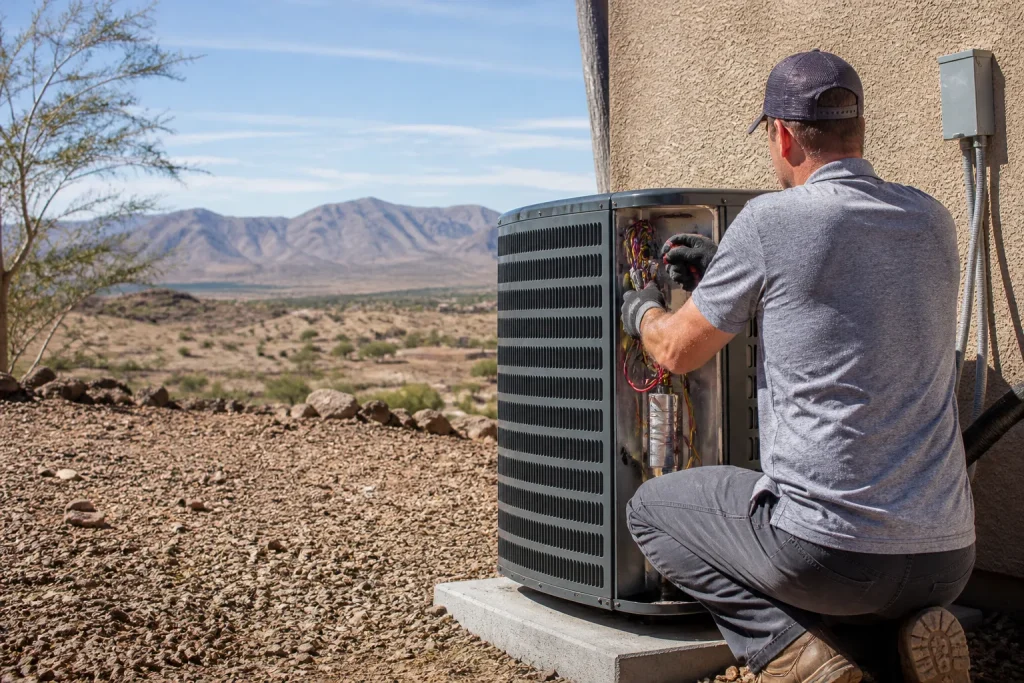
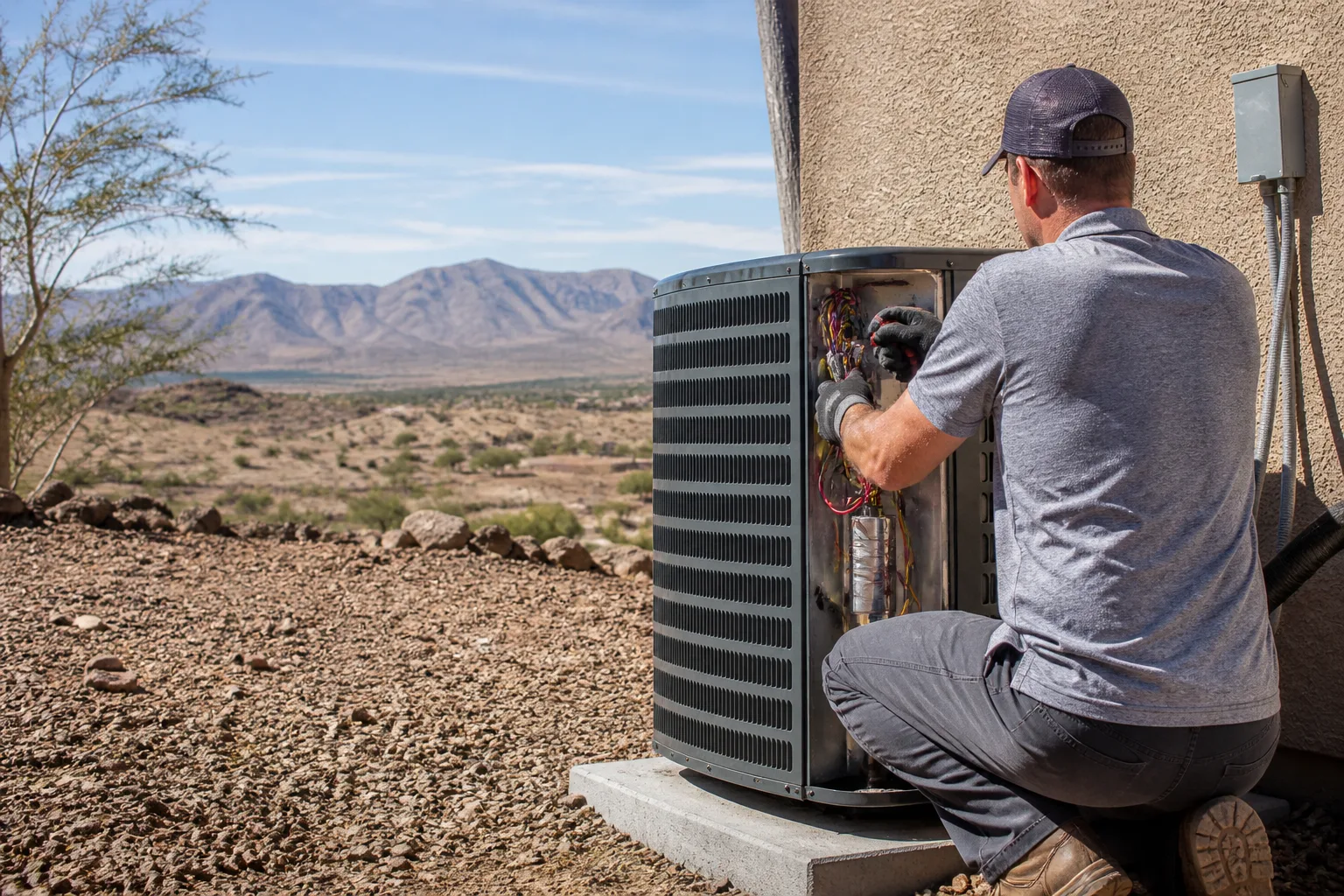
Trane AC Repair in Whitney: A Homeowner’s Guide
Trane’s own slogan, “It’s Hard to Stop a Trane,” may be the reason some Whitney homeowners are sitting in 95-degree houses this July, having ignored the warning signs for two weeks longer than they should have. We understand the logic. You bought a durable machine, so a little rattle or a slightly longer cool-down must be nothing. Here’s the trap: Trane builds tough equipment, but even tough equipment has predictable failure points, and desert heat finds them faster than any other climate. This guide covers what makes a Trane different to work on, which parts need the brand name and which don’t, and what the three most common Trane repairs actually run in this market.
If you’d rather not guess, we’re happy to take a look. Call (888) 691-6715 for a free estimate, fast dispatch from 7am to 7pm, Sunday through Friday.
Why Trane Durability Can Work Against You
A durable system is also a patient one. Trane units tend to keep running through problems that would have shut down a cheaper machine, which means a small refrigerant leak or a tired capacitor can go unnoticed for weeks while the compressor quietly works harder in the background. In Whitney, where summer afternoons push the equipment to its limits, “still running” and “running well” are two very different things.
What we’ve seen in our years working on Trane systems is that homeowners who call at the first sign of trouble usually face a smaller repair than the ones who call after a month of the system limping along. The signs worth taking seriously:
- The house takes longer than usual to reach the set temperature.
- The outdoor unit runs constantly and never seems to hit a rest cycle.
- Air coming from the vents is cool but not cold.
- You hear a rhythmic click or a clunk at startup.
- Electric bills climb without a change in usage habits.
None of these mean your Trane is failing. Each one is worth a diagnosis before it becomes a much bigger line item.
Trane-Specific Components: Where Brand-Matched Parts Matter
Here’s the question that comes up most often, and the honest answer is not the same for every part. Some Trane components should always be replaced with Trane-specified parts to protect your equipment and your warranty. Others are standard across the industry, and an aftermarket equivalent is fine.
Parts that should be brand-matched
- The compressor. This is the heart of the system and the most expensive single component. It should be replaced with the exact model specified for your unit, not a generic equivalent. Mismatched compressors are a fast road to repeat failures.
- The variable-speed blower motor on high-efficiency units. These are programmed for the specific airflow profile of that model. Substituting a different motor changes how the system moves air through the house.
- Control boards and the communicating controller on the XL series. Trane’s communicating systems use proprietary logic. This is not a place for a generic part.
Parts where aftermarket is fine
- Capacitors and contactors. These are commodity electrical parts. A quality equivalent works fine and doesn’t affect your warranty coverage.
- Air filters. Use the size and MERV rating the manufacturer specifies, but the brand on the box is irrelevant.
- Standard contactors and thermostats on non-communicating systems. As long as the specifications match, brand isn’t the deciding factor.
One important caution: if your unit is under a manufacturer’s warranty, using non-approved parts in the wrong place can affect a claim. Check the warranty paperwork before authorizing substitute parts, or ask us to walk through it with you. We work on the brand already in your home, so we’re not in the business of steering you toward a specific manufacturer.
Trane XR and XL in Desert Heat: The Failure Modes We See Most
Trane’s XR and XL series both have reputations for durability, and both have predictable weak points when they run hard through a Whitney summer. The XR series, being the simpler single-stage and two-stage equipment, tends to develop specific problems; the XL series, with its communicating controls and variable-speed components, brings its own set.
XR series in sustained heat
- Capacitor failure. The most common single repair we handle. A failing run capacitor drags the compressor and fan, and in 110-degree heat it happens faster than homeowners expect.
- Contactor pitting. Repeated hard starts wear down the contactor points. The unit may still run, but it starts irregularly.
- Refrigerant leaks at the service valves and flare connections. Thermal cycling stresses metal joints. Slow leaks are the most commonly ignored Trane issue we see.
XL series in sustained heat
- Variable-speed blower module faults. When the blower module fails, the system may run the compressor but deliver weak airflow, which feels like a cooling problem but is actually an airflow problem.
- Communication errors between the indoor and outdoor units. The XL series depends on that link. Faulty wiring or a control board issue shows up as an error code on the thermostat rather than as obvious equipment failure.
- Dirty condenser coils. Dust accumulation on the outdoor coil is a year-round issue in Whitney, and the extra head pressure on a variable-speed system is harder on it than on a single-stage unit.
When the condenser coil is packed with dust, the system can’t reject heat efficiently. Cleaning it isn’t glamorous work, but it’s one of the highest-value maintenance steps for a Trane in this climate.
Reading Your Trane Thermostat Error Codes Before You Call
Trane’s communicating thermostats and control boards display error codes that point to a specific problem. You can read those codes and tell us what you see, which shortens the diagnosis. Do not open the equipment cabinet to investigate further. Electrical components inside hold charge and can cause serious injury, so leave that to a trained technician.
Codes vary by thermostat model, but the ones that come up most often tell a story:
- Airflow codes. These usually point to a filter, a blower issue, or a blocked return. Check the filter first. If you replaced it recently and the code persists, call us.
- Communication codes. These mean the indoor and outdoor units aren’t talking to each other. Often wiring or a control board. Don’t ignore these; the system may run in a degraded mode that stresses the compressor.
- Pressure or temperature lockout codes. These indicate the system shut itself down to protect the compressor. That’s a good sign the safety protections work and a sign you should call.
- Defrost or sensor codes on heat pump models. Worth noting even in summer; these sensors control more than heating.
Write down the code, note what the system was doing when it appeared, and have it ready for the technician. That’s the difference between a fast diagnosis and a longer one. Our technicians have up to 8 years of experience reading these systems, and the more information you can give us upfront, the more directly we can get to the fix.
Why Trane Warranty Claims Require Maintenance Records
This is the part homeowners regret most. Trane’s manufacturer warranties, particularly on compressors on higher-efficiency units, can require documented regular maintenance to remain valid. If your system is under warranty and a repair claim comes up, the first question the manufacturer may ask is whether the unit has been maintained as specified.
What “regular” means in practice, for a unit working hard through a Whitney summer, is more frequent than the owner’s manual might suggest:
- Filter replacement roughly every 30 to 60 days during heavy cooling season, not once a season.
- An annual professional tune-up before the cooling season begins.
- Coil cleaning at least annually in this climate; dust loads faster than in milder parts of the country.
Keep the records. A handwritten list of dates and what was done is genuinely useful when a warranty claim comes up. We’re not a warranty administrator and we can’t speak for the manufacturer, but we can tell you that a lost maintenance record is a much more common reason for a denied claim than an actual equipment problem.
What Trane Repairs Cost in Whitney
The three most common Trane repairs we handle in this market fall into a range, and it’s worth knowing what the ballpark looks like before you call. Every price is set per job by a written estimate, so treat these as typical figures, not quotes.
| Repair | Typical range |
| Capacitor or contactor replacement | $180 to $340 |
| Refrigerant leak detection and recharge | $250 to $600, depending on leak location and refrigerant type |
| Blower motor or control board replacement | $450 to $950, higher for variable-speed modules on XL series |
For context, a full system replacement on a comparable Trane typically runs $6,000 to $11,000 installed. A repair that restores cooling is usually the better move unless the system is into double-digit years with a failing compressor. That’s a conversation worth having honestly, and one of the reasons we’re AC-only: no upselling you into a replacement when a repair is the right call.
When to Call a Pro
If the system has stopped cooling entirely, the thermostat shows a lockout code, or the outdoor unit makes a grinding or arcing sound, stop and call us. Electrical issues inside the equipment are not a homeowner fix, and refrigerant handling requires a licensed technician. Capacitors and wiring can hold a dangerous charge even after power is off, so leave the cabinet closed.
If the system is running but not keeping up, you have a bit more breathing room, but not weeks. A small refrigerant leak or a marginal capacitor usually costs less to fix when it’s caught early. Call (888) 691-6715. We answer 24/7. Fast dispatch from 7am to 7pm, Sunday through Friday.
Related services in Whitney: If we’re heading out to look at a failed system, we can also quote AC installation if the diagnosis points that direction, and routine AC repair is our core work. We also build long-term maintenance relationships so the Trane in your home keeps behaving, and if you’re newer to Whitney, our AC Repair Whitney page covers the local setup.
The Bottom Line
Trane makes a durable machine, and that’s exactly why the “wait and see” approach costs homeowners more than it saves. The failure modes are predictable: capacitors, refrigerant leaks, and (on the XL series) blower modules and communication faults. Parts matter depending on what’s failing, and maintenance records matter far more than most owners realize when a warranty claim comes up.
We work on Trane alongside Carrier, Bryant, and American Standard, because AC is all we do and we know the brand already in your home. Our technicians have up to 8 years of experience diagnosing these systems directly. If you’re in Whitney and need help, AC Repair Whitney offers free estimates. Call (888) 691-6715. We answer 24/7. Fast dispatch from 7am to 7pm, Sunday through Friday. Closed Saturday.
Frequently Asked Questions
Not meaningfully for the most common repairs. Capacitors, contactors, blower motors, and refrigerant work sit in the same range regardless of the brand on the cabinet. Where Trane can cost more is when a proprietary control board or a variable-speed blower module on the XL series needs replacing, because those parts are brand-specific. Call (888) 691-6715 for a free estimate on your exact system.
It depends on the part. Commodity electrical parts like capacitors and contactors are fine with quality aftermarket equivalents. It’s the compressor, communicating controls, and variable-speed blower on the XL series that need brand-matched parts. If your unit is under warranty, ask before authorizing a substitute part. A written estimate from us spells out exactly what’s being replaced.
Repair is usually the right call if the system is under roughly ten years old and the problem is a single component. Replace if the compressor has failed on an older unit, or if you’re facing a second major repair in a short window. Call (888) 691-6715, and we’ll give you a written estimate on the repair and an honest read on whether replacement makes more sense.
Often, yes. We keep same-day slots open for no-cooling calls. Call (888) 691-6715. We answer 24/7. Fast dispatch from 7am to 7pm, Sunday through Friday. Closed Saturday, but a call on Saturday goes into the next opening on Sunday. Estimates are free.
Written by the team at AC Repair Whitney.
Need HVAC Help?
Call AC Repair Whitney - licensed & insured, here with fast help in Whitney.
(888) 691-6715